Paper Trail
By Sean Lang
Published by Lazy Bee Scripts
https://www.lazybeescripts.co.uk
Photo Credit: Paul Ashley
Synopsis
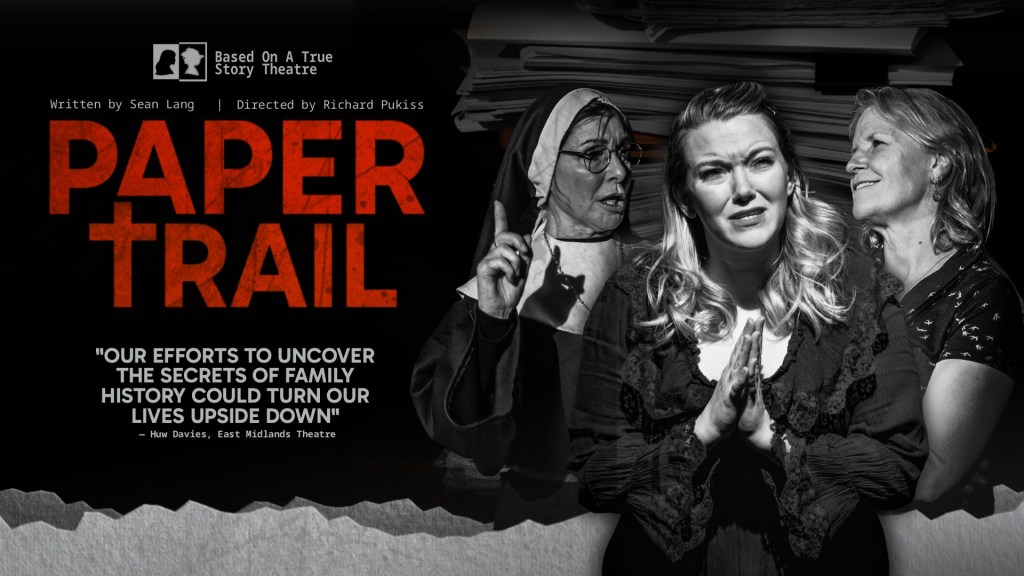
PAPER TRAIL is a one-act play about the hidden secrets that can lie waiting for anyone researching their family history. It has been performed in the UK, Australia, Canada and Ireland.
Mel is a young archivist, working in the small, under-funded archive of a London hospital in the 2000s. She is happy to help historical researchers but rather less tolerant of amateur family history researchers, and she is not too pleased when Angie, a middle-aged Australian lady, arrives without an appointment, needing help to trace her mother. As the mystery surrounding Angie’s birth becomes clear the relationship between Mel and Angie becomes warmer. However, while Mel’s professional training enables her to discover the shocking secret in Angie’s past, it hasn’t prepared her for how to break what will be life-changing news. What should she do?
Paper Trail won Second Place in the Cambridge Drama Festival 2024 with two nominations for best supporting actors and a nomination for best actor. It also won Adjudicator’s Choice and two further best actor nominations at the Welwyn Garden City Drama Festival in May 2025.
Cast
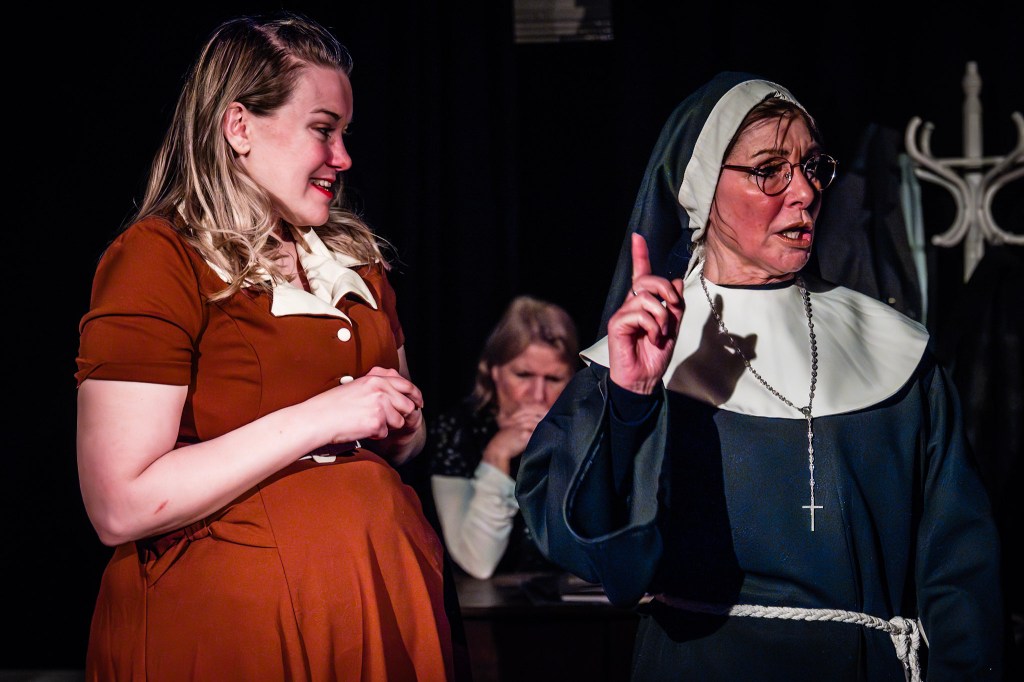
Mel: Penelope Saunders
Angie: Kirsty Smith
Joan: Lucy Green
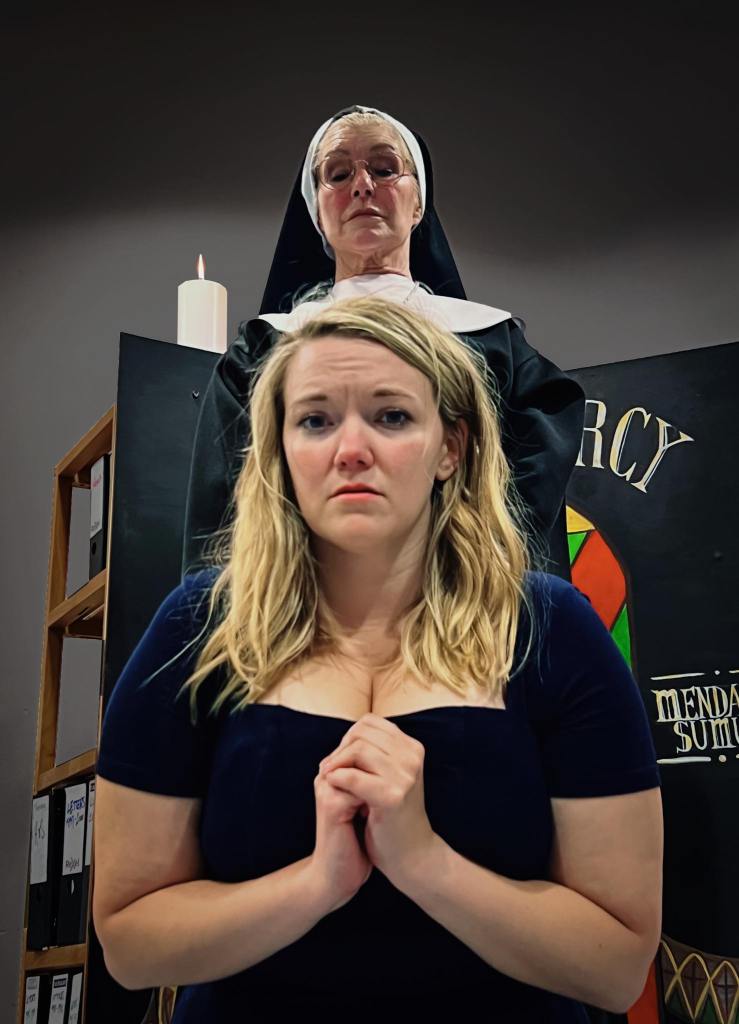
Sister Mary: Beverley Dean
Reviews
Themes
This is a play about identity and about motherhood. Angie is trying to find a record of who her mother was, but she soon finds that she herself is not quite who she thought she was – the TV family history series Who Do You Think You Are? is very well named. Angie remembers how she yearned for a mother when she was a child and she feels a strong pull now to find out the truth of who her real mother was. Mel too has a strained relationship with her mother, though Angie realises that, despite the frustration Mel obviously feels, her attachment to her mother remains very strong. Both Angie and her mother, Joan, have a sort of surrogate mother in the Mother Superior of the Sisters of Mercy, Sister Mary Aloysius; however, while Sister Mary Aloysius presents herself as a caring mother figure, and almost certainly believes she is acting as one, in fact she is betraying the whole concept of motherhood and even denying Joan her rights and role as a mother to her daughter.
This is also a play about the way history can be revealed through old records. The whole idea for the play came from something Sean once witnessed in the archive of a London hospital. If you know how to read them and find your way around them, those dusty old files and scrolls are full of surprises. They often contain many uncomfortable secrets, but what are the ethics of handling what they contain? Archivists are their custodians, but who owns the truths the documents hold? Does Mel have a duty to tell everything, however painful, or should she hold things back?
Based on..
There are three main areas of back story to PAPER TRAIL. One is the story of working class life for women in British cities in the twentieth century; a second is the widespread fashion for family history research that took off in the last couple of decades of the century; the third, and most important in the play, is the story of the Child Migrants.
Joan, the young woman who features in the play’s back story, is born into poverty in London in the 1920s. We often think of the twentieth century as a more ‘modern’ era, but in fact much of the fabric life of British cities remained much as it had been in Victorian times right up to the Second World War and the Blitz. The poverty into which Joan is born and the life choices forced upon her would have been all too familiar to the streetwalkers and prostitutes of Victorian London. She lives in fear of her abusive pimp and looks to the Church for hope and salvation – but the Church betrays her.
Archivists and librarians were noting the increase in the popularity of family history way back in the eighties and interest mushroomed with the launch in 2004 of the BBC series Who Do You Think You Are?, in which celebrities are guided in their search for their roots, often finding painful surprises along the way. We all of us like to have an idea of our origins and who we are, but if – as often happens – the evidence suggests that our cherished stories are not actually true, it can be deeply upsetting. The people on the ‘front line’ are the archivists who do so much to help people to find and make sense of the documents: it’s a heavy burden – are they prepared for it?
The child migrants programme operated from the 1940s to the 1960s, and thousands of British children were shipped out to Commonwealth countries, yet for years the programme was almost completely forgotten in Britain: Mel’s bewilderment when Angie tells her about it is quite genuine for the 2000s. It was in 2008 that the journalist Charles Wheeler made a powerful radio series telling the story and it was not until well into the 2010s that the story began to be more widely known. Briefly, children from British children’s homes and orphanages were shipped out in large numbers in the expectation that they would have better life chances; there was also an idea, especially in Australia, of exporting white ‘racial’ genes to their new homelands. What emerged when the story began to be better known were stories of appalling cruelty and abuse that many of the children encountered in their new homes. Perhaps even more chilling were the revelations that in many cases charitable organisations, some of them well known and respected and including many religious societies, routinely lied to children and to their mothers, telling them their children or their parents were dead. Many children grew to middle and old age still not knowing who they really were.
This is the story of PAPER TRAIL.
 Based on a True Story Theatre