So Much for Buckingham
By Sean Lang
Photo Credit: Lucinda Price
Synopsis
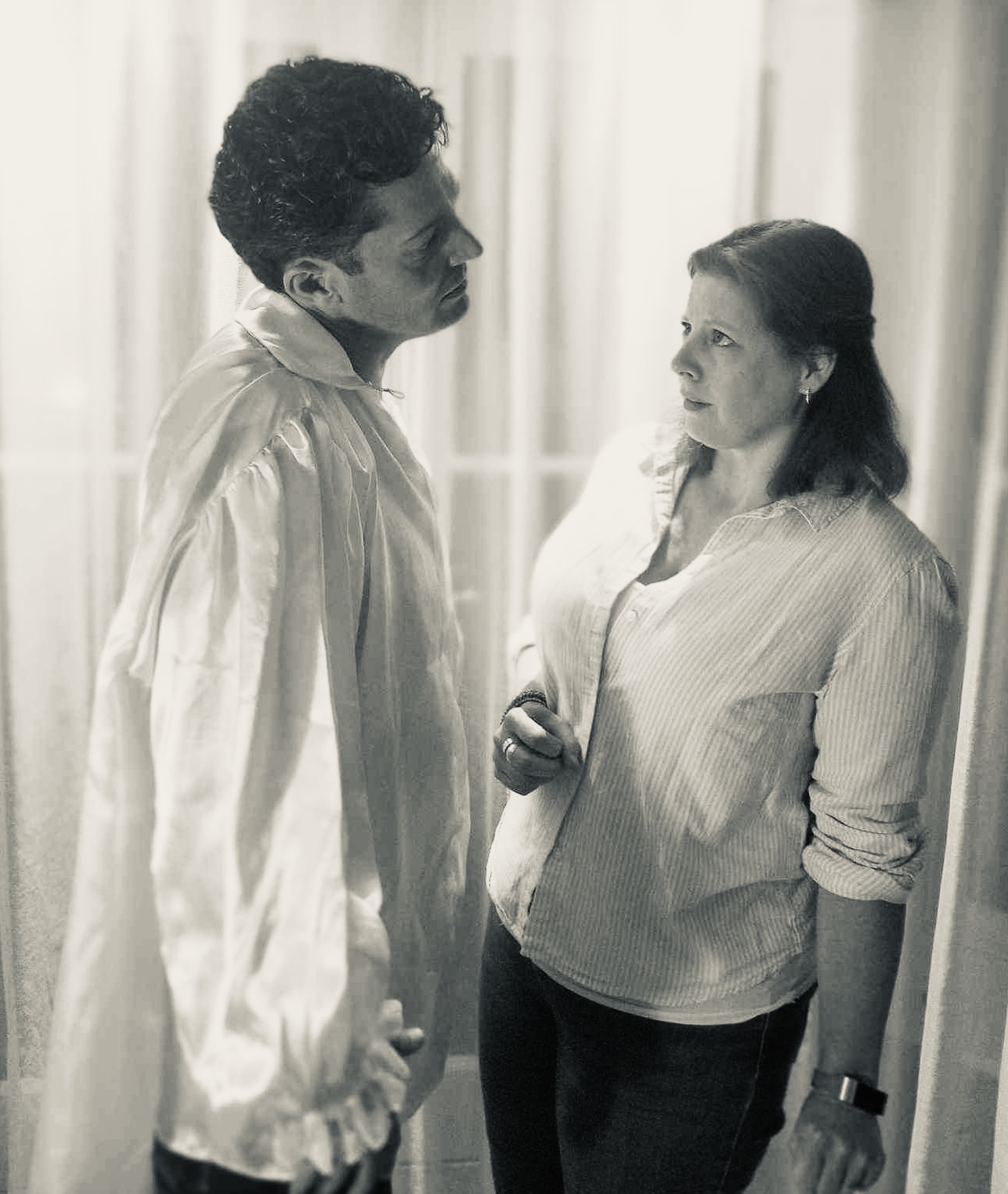
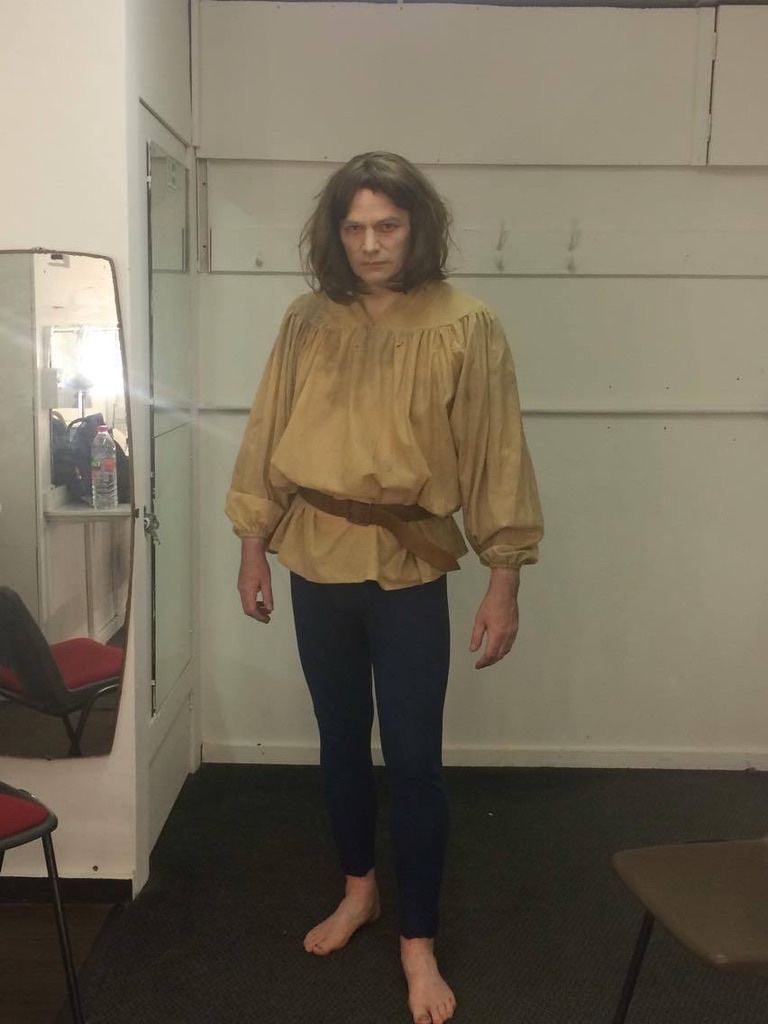
Late one night in 2013, Alison, an enthusiastic ‘Ricardian’ (that is, a defender of the reputation of King Richard III), creeps to the place in a Leicester car park where his body was found to ‘commune’ with his spirit (believe it or not, this sort of thing is quite common in graveyards and at archaeological sites!) She gets more than she bargained for when Richard’s spirit appears before her. Not only does he not fit into her positive image of him, but he may turn out to be worse than she could have ever imagined.
So Much for Buckingham won first place and Best New Play at the 2015 Sawston Drama Festival. At the 2024 Cambridge Drama Festival, Lucy Woodcock was nominated for best actor in her role as Alison.
Themes
The obvious theme in this play is the rather starry-eyed enthusiasm of Richard’s modern defenders, who not only refuse to accept that he murdered the Princes in the Tower, but insist on seeing him as a heroic and virtuous king. The play imagines how they might react if they were to discover from the man himself that he was nothing like the idealised figure they have imagined.
However, the play has a much deeper level of meaning. When Alison discovers that Richard is not as she has imagined, and especially that he quite openly tells her that he did indeed have the Princes in the Tower murdered, she doesn’t just refuse to believe it: she tells him that the truth of the matter is of less importance than the version she and others put out, because the past must always give way to the present. In the end, as Richard points out, the conflict between them is not about Richard, or even about history – it is about power. Control of the past can confer power, and the truth of it is less important than who has that power.
Based on..
King Richard III was one of the figures caught up in the appallingly bloody conflict for the English crown that dominated the fifteenth century. The conflict had begun with a coup d’état in 1399 orchestrated by Henry Bolingbroke, Duke of Lancaster, which overthrew the seriously incompetent King Richard II. However, Henry didn’t just claim he could rule better than Richard II (which was probably true); he claimed he had a better claim to be king in the first place. He, his son and his grandson ruled England as Henry IV, Henry V and Henry VI, known as the House of Lancaster from Henry Bolingbroke’s original title. The Lancastrians might have carried on ruling, but King Henry VI, who inherited the throne as a baby, proved both sickly and completely uninterested in the business of kingship – in effect, he represented a power vacuum. Almost inevitably another member of the Plantagenet dynasty, this time the Duke of York, seized the chance to declare not only that he could do a better job of ruling the country than Henry VI (not that difficult, frankly) but that – because of the 1399 coup that brought the House of Lancaster to the throne in the first place – he had a better right to the throne. Not surprisingly, the two sides soon began to fight each other.
The two sides in the wars that followed were known as Lancastrians and Yorkists (nothing whatever to do with the modern counties of Lancaster and Yorkshire, by the way – in fact, Yorkshire largely supported the Lancastrian cause!) The wars themselves were bitter: the 1461 Battle of Towton remains the most bloody battle ever fought on British soil. The Duke of York himself was captured and executed by the Lancastrians, but his sons managed to defeat the Lancastrians and take the throne. The eldest of them (okay, there had been an elder son, but he had died in the fighting) ruled as King Edward IV. Edward IV was a notorious womaniser but he did leave two legitimate sons, his heir Edward and a younger son Richard, who inherited the family title as Duke of York. The boys’ uncles, Edward IV’s brothers, were George, Duke of Clarence, who was executed for treason, and Richard, Duke of Gloucester. When Edward IV died in 1483 the throne passed to his elder son, who became Edward V.
This was when Richard of Gloucester made his move. He took control of the young king and his little brother and moved them to the Tower of London; this is why they are known to history as The Princes in the Tower. Richard then arranged for it to be declared that the boys were in fact illegitimate (their father had been a notorious philanderer, remember), which left him as the sole remaining heir. He was declared King Richard III.
Murderer or martyr?
Richard had no qualms about arranging the death of rivals or enemies. In a dramatic scene (which features in Shakespeare’s play) he had the loyal and powerful Lord Hastings arrested and executed for treason – a pretty clear case of judicial murder. When his ally the Duke of Buckingham turned against him and rose in rebellion against him, Richard defeated him in battle and had him executed.
However, the biggest controversy concerns the fate of the young princes in the Tower of London. Once they had gone into the Tower not only did they never come out, but they were never seen alive again. The obvious inference is that Richard, who, after all, had compelling reasons to do so, had ordered them to be murdered; however, Richard’s supporters angrily deny it and suggest all sorts of elaborate alternative theories with different culprits. Hardly surprisingly, there is no definitive proof either way, but the consensus among historians of the period is that Richard was almost certainly responsible for their deaths.
Richard III’s reign was relatively short because in 1485 he was overthrown and killed in battle at Bosworth by Henry Tudor, Earl of Richmond. Henry Tudor had a very tenuous claim to the throne through the Lancastrian line; after Richard’s death he moved quickly to establish and strengthen his own claim as legitimate. Henry took the title Henry VII and his reign founded what we know as the Tudor dynasty (his son was Henry VIII and Elizabeth I was his granddaughter). An important part of Henry Tudor’s way of getting himself accepted as King was to launch a major propaganda campaign, portraying Richard III not only as a usurper but as a tyrant and murderer – a monster, in short. This propaganda image continued throughout the Tudor period, which is why we find Shakespeare repeating it in his play a hundred years later. Shakespeare also made much of the stories suggesting that Richard had been a hunchback – hunchbacks were for many centuries believed to be deformed creatures in the service of evil and to bring bad luck.
Shakespeare’s plays remained popular for centuries but their text was often changed to reflect changing tastes. In the eighteenth century the writer Colley Cibber revised Shakespeare’s text to add a number of more ‘juicy’ touches, notably Richard’s dismissive line after Buckingham is taken off to his death – So much for Buckingham!
The king in the car park
There have always been plenty of people who have rejected Shakespeare’s version of Richard and have defended his reputation. They were particularly inspired by the 1951 novel The Daughter of Time by the crime writer Josephine Tey, which imagines a fictional detective investigating the evidence surrounding the princes’ disappearance and concluding that Richard was not responsible; since the book is so often cited by Richard’s defenders, it is worth stressing that it is a fictional piece of fancy! Nevertheless, the Ricardian camp gradually grew in numbers and influence. Its biggest moment of triumph came in 2013, when a long investigation spearheaded by Philippa Langley succeeded in identifying the last resting place of Richard III’s body after the Battle of Bosworth, though by then it lay under a municipal car park. It was a remarkable piece of archaeological detective work; it even enabled a reconstruction to be made of Richard’s face. However the Ricardians also claimed that the discovery somehow justified their case that Richard was a wronged man; in fact, his spine showed severe distortion, suggesting that Shakespeare’s picture of Richard as a hunchback did actually have a basis in fact.
A 2022 film of the discovery of the body, The Lost King, reflected the Ricardian view and showed Philippa Langley and her fellow enthusiasts facing hostility and prejudice by the School of Archaeology at Leicester University; the academics were sufficiently upset to sue the film makers for misrepresentation and they won their case. You can say what you like about the dead, but you have to be careful with the living – they can bite back!
 Based on a True Story Theatre